Story Information
Story Statistics
2,345 Reads
80 Shares
320 Likes

1 year ago
Planting Trees to Save Red Pandas
The red panda (Ailurus fulgens) is a unique and fascinating species whose special cuteness draws a lot of attention. However, red pandas are much more than just a pretty face; they’re an important flagship species for the Eastern Himalayan Ecoregion — one of the most biodiverse places in the world.
Their presence in the forests of Nepal, India, Bhutan, and China indicates a healthy and thriving ecosystem. Without them, it’s a sign that the whole forest is in danger.
Unfortunately, red pandas are endangered; there may be as few as 2,500 red pandas remaining in the wild with a global decline of 50% in just 20 years. This important species deserves to be protected and conserved, along with their habitat.
Wild red panda in Nepal. Credit: RPN
Red pandas face many threats in the modern world, including poaching, and predation (or disease) by free-roaming dogs. However, the #1 threat to red panda’s survival is habitat loss fueled by unstainable livestock management and resource harvest practices, deforestation, and climate change.
As a tree-dwelling species, red pandas struggle to survive when forests are fragmented and degraded. Without tree cover and bamboo to eat, the red panda is left vulnerable and populations become susceptible to bottlenecks, which reduce genetic variation and make it harder for populations to adapt.
Unfortunately, much of the red panda habitat in Nepal has been deforested and degraded; 70 percent of red panda habitat lies outside of protected areas and is fragmented into 400 small forest patches.
Red Panda Network (RPN) began to take action against this ongoing challenge to red pandas’ survival in 2015, initiating a habitat restoration program. Since then, this initiative has blossomed into one of RPN’s flagship campaigns, Plant a Red Panda Home, which was launched officially in 2020!
Through land purchase and tree planting, this campaign successfully restores core habitats and connects fragmented forests, creating a wildlife corridor crucial for sustaining a viable red panda population. By combatting the #1 threat to red pandas, we aim to see this important species thriving in harmony with their ecological community once more.
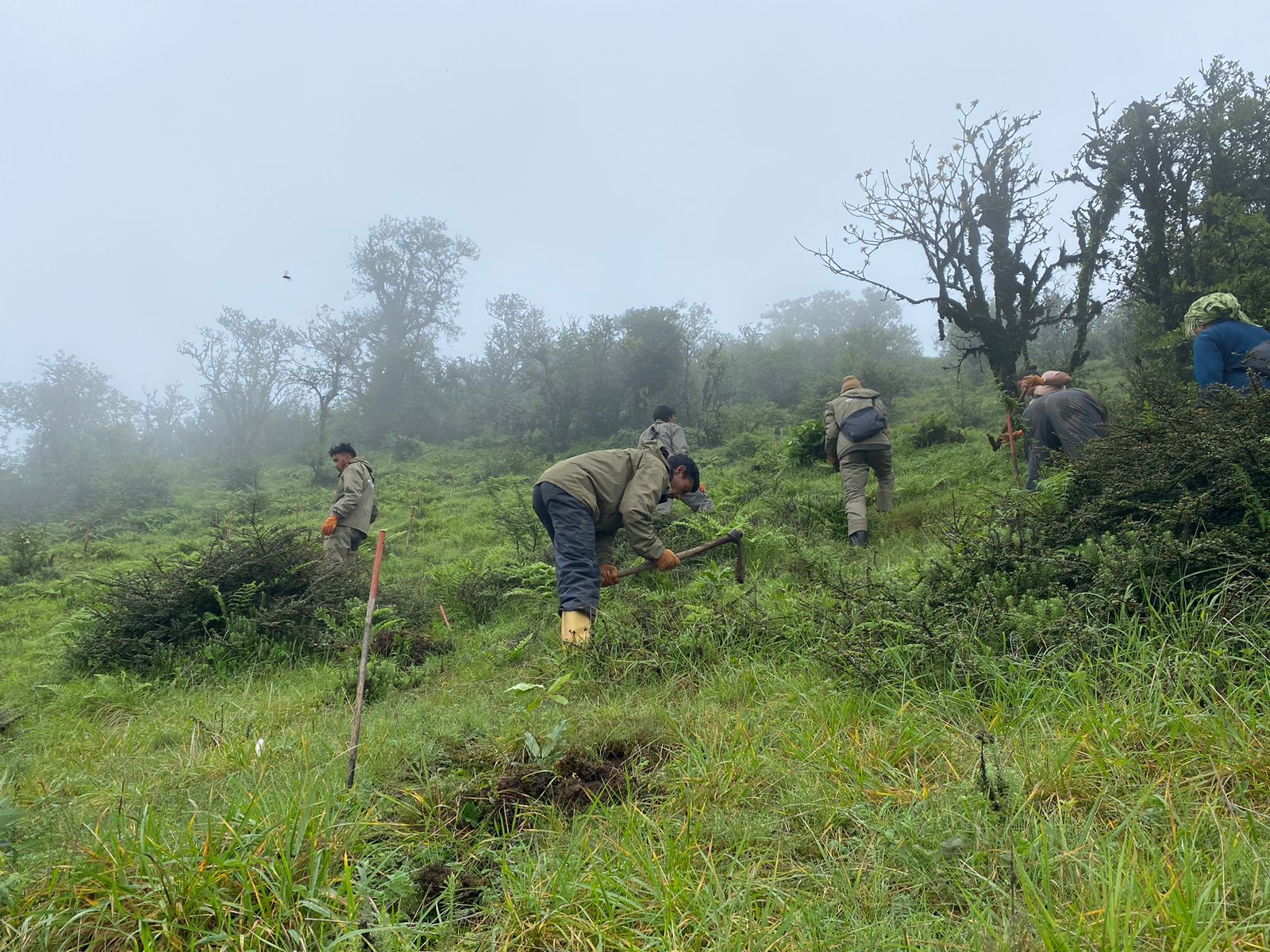
Restoration Guardians planting in Jaubari, Ilam. Credit: RPN 2024
A majority of our restoration efforts are centered in the Panchthar-Ilam-Taplejung (PIT) corridor, home to the densest population of red pandas in Nepal and part of the Eastern Himalayan Broadleaf Forests: a region recognized as an important area for global biodiversity conservation by a number of leading international conservation organizations, including WWF, BirdLife International, and Conservation International.
This critical area is where we are working to establish the PIT Red Panda Protected Forest, which will connect the tri-national Kanchenjunga Conservation Area with India’s Barsey Rhododendron Garden and Singhalila National Park, creating an uninterrupted stretch of protected land extending across 11,500 square km. The PIT Red Panda Protected Forest will be the largest protected forest in Nepal and the first to be managed as a network of community forests!
Jaubari, Ilam district, is a priority location in the PIT corridor for habitat restoration. This area is crucial for establishing habitat contiguity for red pandas as it directly connects the unprotected forest areas of Nepal with protected areas in Nepal and India. Jaubari’s once flourishing forests have been utilized as pastureland and deforested for timber for more than 172 years, resulting in severe degradation of the habitat and leaving over 1665 acres barren.
However, 9 years of dedicated work in this region is showing major improvements to the landscape. Between 2019 and 2023 alone, we have seen a 5% increase in tree cover and an 8% decrease in combined barrenland and settlement areas. Through reforestation initiatives and protective measures like fencing, we are successfully contributing to positive ecological changes in crucial red panda habitat.
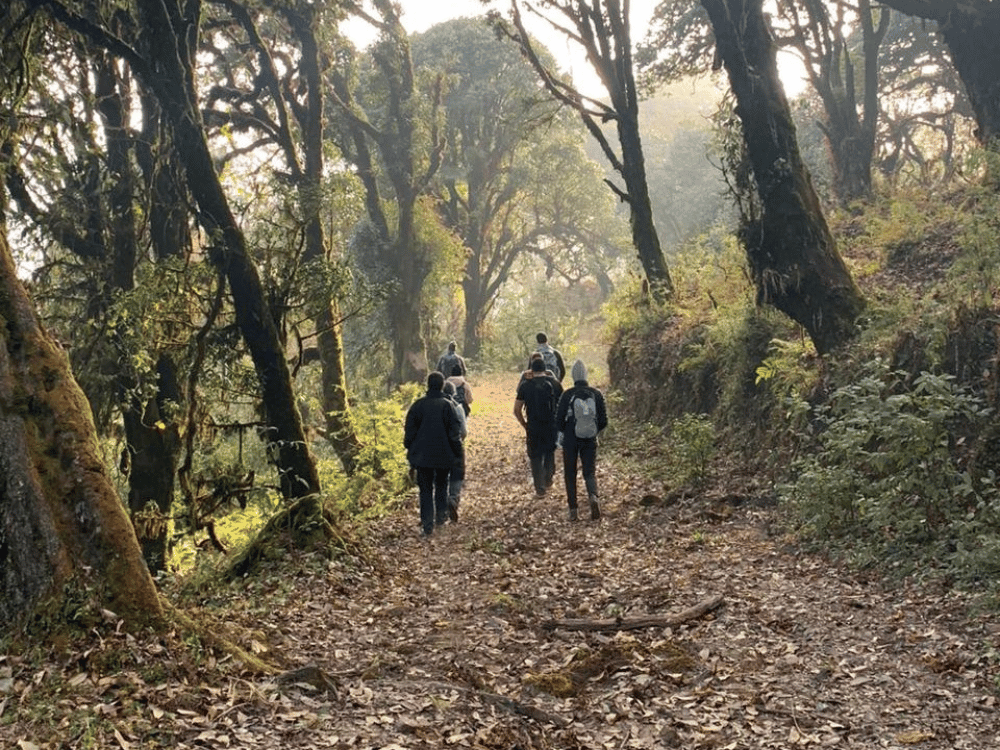 Participants of RPN ecotrip hiking in red panda habitat in Ilam district. Credit: RPN 2024
To reforest these critical habitat areas we work closely with local communities to grow, plant, and manage native trees across the degraded landscape. This work wouldn’t be possible without the knowledge and dedication of local heroes, like our Restoration Guardians who work directly on our restoration sites, and the support of Panda Guardians who give monthly.
We understand that red panda conservation requires a holistic approach; we view our restoration work the same way. From growing seedlings in our nurseries to post-planting care, our team remains committed to the restoration and survival of red panda habitat throughout the lifetime of the forest.
In 2023, we purchased 65,921 seedlings from pre-existing restoration nurseries managed by local communities. Of all the purchased and ready seedlings in the restoration nursery, almost 41,000 seedlings of different native species were planted in the Jaubari Restoration Site that year!
Our growing potential continues to expand; we constructed three new conservation nurseries with a capacity of approximately 22,680 seedlings for sapling germination in Nepal’s Jaubari and Tumling in 2023.
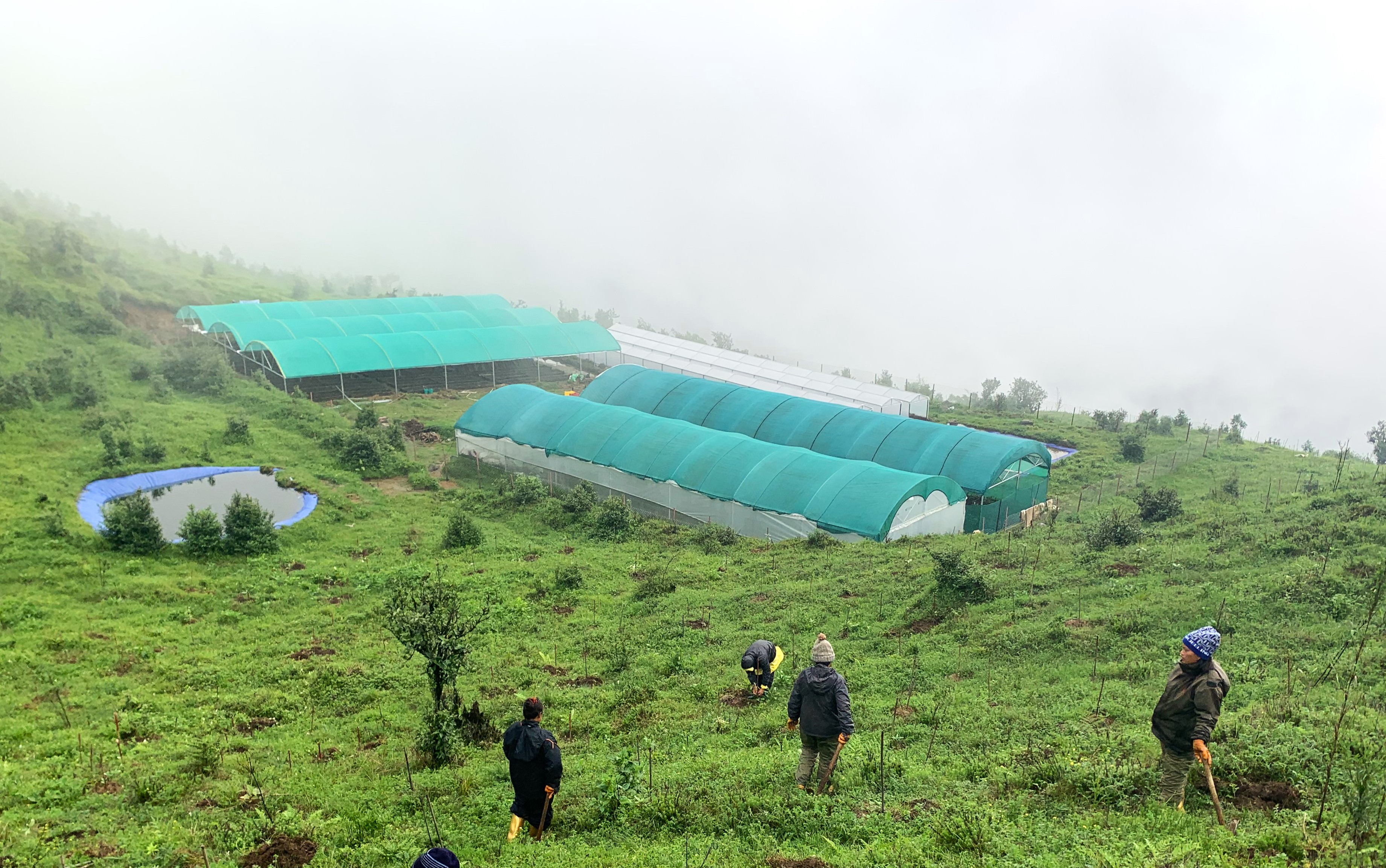
Forest nurseries at Jaubari restoration site. Credit: RPN 2024
Before we plant the seedlings into the earth, we install fences around the restoration site to protect the young seedlings from livestock. Using a strategic combination of mesh wire and bamboo-mesh fencing, these fences prevent livestock entry without affecting the movement of wildlife like red pandas.
Once the fences have been constructed, Restoration Guardians begin planting diverse native seedlings across the landscape. Since the initiation of Plant a Red Panda Home in 2019, we have planted over 650,000 trees in degraded areas. As of today, in June of 2024, we have already planted 10,342 seedlings in degraded areas of Ilam this year alone!
.jpg)
Restoration Guardians planting trees in Jaubari, Ilam. RPN 2022.
To increase the survival of the seedlings, we carry out post-planting care throughout the year. We conduct weeding, staking, and mulching of the planted seedlings, as well as regular monitoring of the trees’ growth and health.
We are proud of the successes of this habitat restoration project and are excited to see its continual impact on local communities of pandas, people, and plants alike. Not only have we seen improved tree cover in our restoration sites, but we have also seen improved presence of red pandas in these areas, as well!
Best of all, our restoration work employs local people in green jobs that help foster a sustainable future for the people who live among the pandas. Through eco-skill-building, employment with RPN, and better green spaces, we are seeing the lives of our communities changing for the better.
“Red Panda Network has been helping us restore our degraded forests for eight years now; the Jaubari community is very happy that they are here,” says Thupten Bhutia, a local community member. “Wildlife that hasn’t been seen here for years — like Himalayan black bear, red muntjac, leopard and even red panda — are now visiting the reforested habitat.”
These successes are only possible with supporters like you, who help us purchase degraded land, buy and grow seedlings, and employ local people. Your support makes a difference; become a Panda Guardian today to make a lasting impact on red panda habitat restoration in Nepal and beyond.